
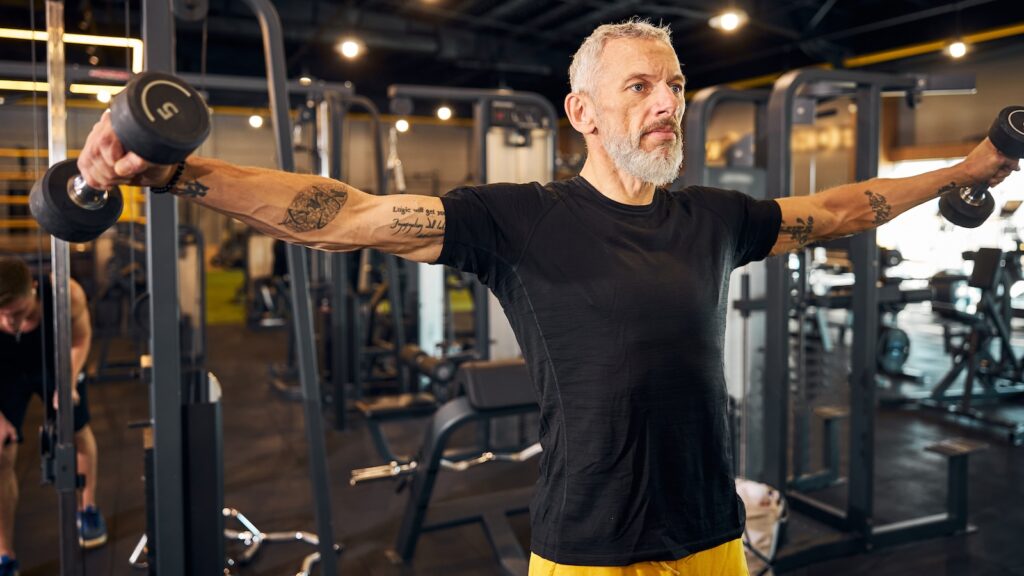
The latest hypertrophy research unveil the best methods to construct the medial delts.
Final up to date on January 14th, 2025

Home of Hypertrophy (HoH) not too long ago examined the primary research to match muscle development from cable versus dumbbell lateral raises. These variations isolate the medial head of the deltoids, pivotal to the X-frame physique or hourglass aesthetic.
Whereas each workout routines contain arm abduction (lifting arms laterally), they’ve barely totally different resistance profiles. Standing cable laterals supply a greater stretch on the backside, which makes them a bit more difficult to begin. Dumbbells are the other. Does that matter for development?
The Research on Dumbbells vs. Cables
Twenty-four volunteers (16 males and eight girls) with a median of seven.1 years of coaching expertise participated on this research. (1) They had been randomly assigned cable lateral raises to 1 arm and dumbbell lateral raises for the opposite arm utilizing wrist cuffs to rule out grip fatigue.
Each variations had been carried out from 0-to-90 levels, with arms angled barely ahead for shoulder consolation. Cables had been aligned with palms within the beginning place, with arms by sides. Cable raises are more difficult within the beginning place when the medial delts are most lengthened; dumbbell laterals are most difficult at 90 levels.
5 units per train to failure within the 12-16 rep vary had been carried out twice weekly for eight weeks. They progressively overloaded the actions over the research’s length.
“This design of all topics coaching each workout routines is nice as variations in genetics, diet, and out of doors way of life elements are much less prone to confound the findings,” HoH defined.
[Related: Latest Meta-Analysis on Training Frequency for Hypertrophy]
Which Is Higher?
Knowledge from the research revealed that “Each dumbbell and cable lateral raises are equally efficient for growing lateral deltoid muscle hypertrophy in resistance-trained lifters.”
Use warning when forming conclusions from a single research. Rising the vary of movement and rep tempo may skew the outcomes.
Muscle Size and Hypertrophy
A number of current research evaluating hypertrophy used totally different coaching variables in three classes:
- Resistance Problem: Workout routines are most difficult when muscle groups are lengthened versus shortened.
- Vary of Movement: Full vs. partial vary of movement.
- Biarticular Muscle groups: Muscle groups crossing two joints.
Resistance Problem
For the reason that medial delt research is most much like the resistance problem, examine it to the one equal research from 2020, evaluating barbell preacher curls, that are more difficult when the arms are prolonged, to cable preacher curls, that are more difficult throughout contraction. (2) There was nearly no distinction in development.
Vary of Movement
Science conflicts concerning full vary of movement versus partial reps. Just a few research deemed stretched partials higher than full-motion reps, however the topics had been untrained. (3) Knowledge on educated people noticed that each equally maximize hypertrophy.
From this information, coaching at longer lengths, whereas efficient, isn’t essentially superior for hypertrophy.
Biarticular Muscle groups
A research evaluating development within the quadriceps, a biarticular muscle, utilizing totally different joint angles throughout leg extensions, discovered that the rectus femoris — the one quad crossing each the hip and knee joints — grows higher with a reclined torso. This, mixed with adjusting the leg lever again underneath the seat, optimally lengthens the rectus femoris. (4)
Related findings apply to the hamstrings, triceps, and calves. (5)(6) Most of those research concerned untrained individuals.
Greatest for Muscle Good points
Whereas the analysis isn’t fully conclusive, HoH’s “suspicion is [biarticular muscles] is the class the place educated people will see higher development from longer muscle lengths.”
Burke and colleagues’ 2024 article demonstrates higher calf development from standing versus seated calf raises in educated people. (7) The aforementioned leg extension research was carried out with aggressive bodybuilders.
The takeaways are, “Don’t be afraid to experiment; coaching arduous with sufficient quantity and consistency are crucial issues for constructing muscle,” HoH concluded.
Extra In Analysis
References
- Larsen, S., Wolf, M., Schoenfeld, B. J., Sandberg, N. Ø., Fredriksen, A. B., Kristiansen, B. S., … Falch, H. N. (2024). Dumbbell versus cable lateral raises for lateral deltoid hypertrophy: an experimental research. Retrieved from https://sportrxiv.org/index.php/server/preprint/view/487#:~:textual content=Inpercent20conclusionpercent2Cpercent20ourpercent20datapercent20suggests,hypertrophypercent20inpercent20resistancepercent2Dtrainedpercent20lifters.
- Nunes, J. P., Jacinto, J. L., Ribeiro, A. S., Mayhew, J. L., Nakamura, M., Capel, D. M. G., Santos, L. R., Santos, L., Cyrino, E. S., & Aguiar, A. F. (2020). Inserting Larger Torque at Shorter or Longer Muscle Lengths? Results of Cable vs. Barbell Preacher Curl Coaching on Muscular Energy and Hypertrophy in Younger Adults. Worldwide journal of environmental analysis and public well being, 17(16), 5859. https://doi.org/10.3390/ijerph17165859
- Wolf, M., Korakakis, P. A., Piñero, A., Mohan, A. E., Hermann, T., Augustin, F., … Schoenfeld, B. J. (2024). Lengthened Partial Repetitions Elicit Related Muscular Diversifications as a Full Vary of Movement Throughout Resistance Coaching in Educated People. Retrieved from https://sportrxiv.org/index.php/server/preprint/view/455
- Mitsuya, H., Nakazato, Okay., Hakkaku, T., & Okada, T. (2023). Hip flexion angle impacts longitudinal muscle exercise of the rectus femoris in leg extension train. European journal of utilized physiology, 123(6), 1299–1309. https://doi.org/10.1007/s00421-023-05156-w
- Maeo, S., Wu, Y., Huang, M., Sakurai, H., Kusagawa, Y., Sugiyama, T., Kanehisa, H., & Isaka, T. (2023). Triceps brachii hypertrophy is considerably better after elbow extension coaching carried out within the overhead versus impartial arm place. European journal of sport science, 23(7), 1240–1250. https://doi.org/10.1080/17461391.2022.2100279
- Kinoshita, M., Maeo, S., Kobayashi, Y., Eihara, Y., Ono, M., Sato, M., Sugiyama, T., Kanehisa, H., & Isaka, T. (2023). Triceps surae muscle hypertrophy is larger after standing versus seated calf-raise coaching. Frontiers in physiology, 14, 1272106. https://doi.org/10.3389/fphys.2023.1272106
- Burke, Ryan & Piñero, Alec & Mohan, Adam & Hermann, Tom & Sapuppo, Max & Augustin, Francesca & Coleman, Max & Androulakis-Korakakis, Patroklos & Wolf, Milo & Swinton, Paul & Schoenfeld, Brad. (2024). Train Choice Differentially Influences Decrease Physique Regional Muscle Growth. Journal of Science in Sport and Train. 10.1007/s42978-024-00299-4.
Featured picture by way of Shutterstock/YAKOBCHUK VIACHESLAV