
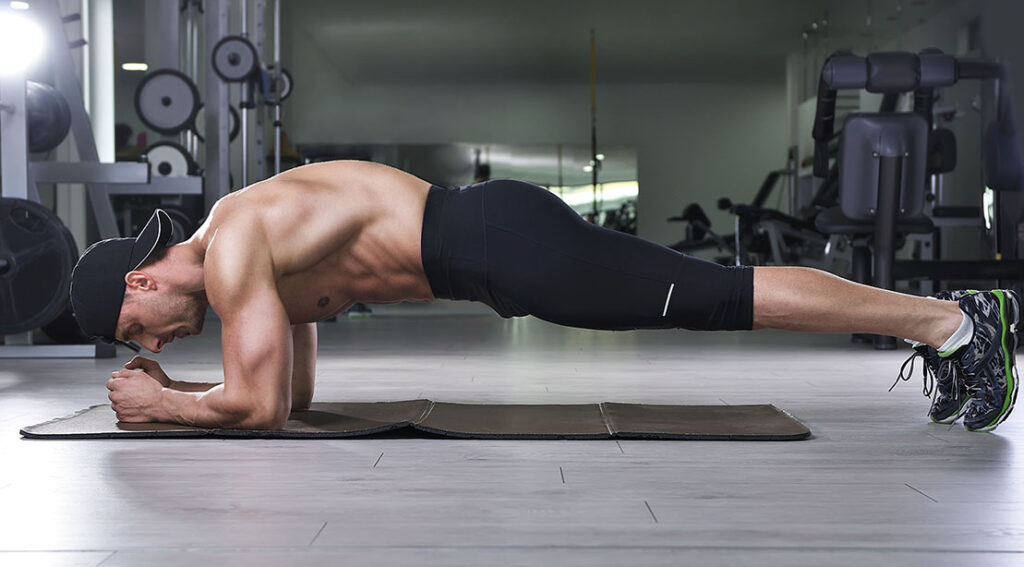
Though a superb train, the usual entrance plank is a bit ho-hum. There have been many individuals who’ve turned it right into a take a look at of endurance in any respect prices. The present World record for the Front Plank is 9 hours, 38 minutes, and 47 seconds, set by Josef Šálek from the Czech Republic. I don’t find out about you, however there are one million and one issues that I’d quite be doing than planking for that lengthy, like sleeping. However you don’t have to make a world file try each time you do the Entrance Plank. You want extra rigidity, and that’s the place the RKC Plank comes into play.
The RKC Plank (Russian Kettlebell Problem Plank) takes the normal plank and turns up the depth by emphasizing full-body rigidity.
As a substitute of passively holding it, the RKC Plank requires you to have interaction your glutes, quads, lats, core, and grip—making a high-tension isometric contraction that delivers core features in simply 20 seconds.
Able to construct an iron core? Let’s dive into all issues RKC Plank on your core-strengthening pleasure.
What’s the RKC Plank?
Whereas the RKC plank seems to be just like a typical forearm plank, it’s a high-tension, full-body train that will increase engagement. The important thing distinction? As a substitute of holding a plank place, you create as a lot rigidity as attainable all through your physique.
Within the RKC Plank, you:
- Squeeze your glutes and quads.
- Pull your elbows towards your toes with out truly shifting them.
- Brace your core and breathe into your stomach whereas sustaining full-body rigidity.
This strategy solves the principle difficulty with common planks: a scarcity of rigidity and core activation. Now that you understand what it’s, let’s study methods to carry out it effectively.
How To Do The RKC Plank
To do it proper, comply with these step-by-step directions:
- Begin in a forearm plank place, along with your elbows immediately underneath your shoulders and ft hip-width aside, and clench your fists and press your forearms into the bottom.
- Squeeze your glutes and quads as exhausting as attainable.
- Pull your elbows towards your toes and your toes towards your elbows with out shifting them.
- Breathe deeply, however don’t lose rigidity; maintain for 10-20 seconds.
- Launch and reset between reps to make sure most contraction every time.
RKC Plank Muscle tissues Educated
The RKC Plank isn’t simply an ab train—it’s a full-body rigidity motion that engages a number of muscle mass concurrently. Right here’s what it targets and the way every muscle contributes to it.
- Rectus Abdominis: Maintains a inflexible torso and resists spinal extension.
- Transverse Abdominis: Creates intra-abdominal stress, defending the backbone.
- Obliques: Forestall lateral motion whereas enhancing rotational stability.
- Decrease Again: Helps hold the backbone impartial underneath rigidity.
- Glutes: Actively squeezing your glutes protects and strengthens your decrease again.
- Quadriceps: Tensing your quads enhances general rigidity.
- Lats: Pulling your shoulders down and in improves higher physique stability.
- Shoulders & Traps: Retains your higher physique inflexible and prevents pointless motion.
- Forearms: Making tight fists helps activate extra muscle and reinforces full-body rigidity.
Frequent RKC Plank Type Errors and Fixes
When achieved accurately, the RKC Plank is very efficient, however small errors can cut back its advantages. Listed below are the commonest errors and methods to repair them.
Not Creating Sufficient Stress
Holding the plank passively with out partaking all of the muscle mass required for rigidity. Repair: Actively squeeze your glutes, quads, and fists whereas pulling your elbows towards your toes. In case you can simply maintain the place for over 20 seconds, you’re not contracting exhausting sufficient.
It’s All In The Hips
Sagging hips pressure the decrease again, whereas lifting them too excessive shifts the main target away from the core. Repair: Hold your hips aligned along with your shoulders and keep a impartial backbone by squeezing your glutes and bracing your abs.
Holding Your Breath
Many individuals instinctively maintain their breath, significantly throughout isometric workout routines just like the RKC plank, which results in rigidity loss and extra fatigue. Repair: Breathe down into your stomach by inhaling by way of your nostril and exhaling out of your mouth.
Holding for Too Lengthy
You’re doubtless dropping rigidity in case you maintain the RKC Plank for over 30 seconds. Repair: As a substitute of specializing in time, maximize rigidity and contract exhausting for 10-20 seconds per set.
Advantages of the RKC Plank
The RKC Plank is a full-body energy train that improves core stability, posture, and lifting efficiency. Right here’s why it deserves a spot in your exercises:
Enhances Core Energy
By partaking the rectus abdominis, transverse abdominis, obliques, and erector spinae, the RKC Plank strengthens the core to withstand motion and keep stability underneath duress. That is vital for heavy lifting, athletic efficiency, and damage prevention. The RKC Plank requires correct bracing strategies, which has direct carryover to heavy lifting.
Full-Physique Stress
The RKC Plank isn’t nearly your core—it requires total-body activation. Each muscle performs a task in sustaining rigidity, out of your glutes and quads to your lats and shoulders. This degree of engagement mimics the soundness wanted for compound lifts, making it a helpful instrument for lifters seeking to enhance their efficiency.
Strengthens The Decrease Again and Improves Posture
Weaker core muscle mass typically result in poor posture and decrease again ache. The RKC Plank reinforces impartial backbone positioning, serving to you construct the energy essential to help your decrease again in day by day life and lifting. Studying to have interaction the glutes correctly, brace the core, and management respiratory reduces pointless spinal motion and decrease again discomfort.
PROGRAMMING SUGGESTIONS
Right here’s methods to incorporate the RKC plank into your exercises.
Core Energy: 3-4 units of 10-20 seconds.
Heat-Up: 1-2 units of 10-15 seconds earlier than heavy lifts.
Supersets: Add it between squats, deadlifts, or presses for enhanced core activation.
The right way to Progress
Enhance rigidity: Give attention to contracting more durable, not simply holding longer.
Add weight: Place a light-weight weight plate in your again for added resistance.
Use breath management: Attempt exhaling exhausting to extend the depth with every breath.