
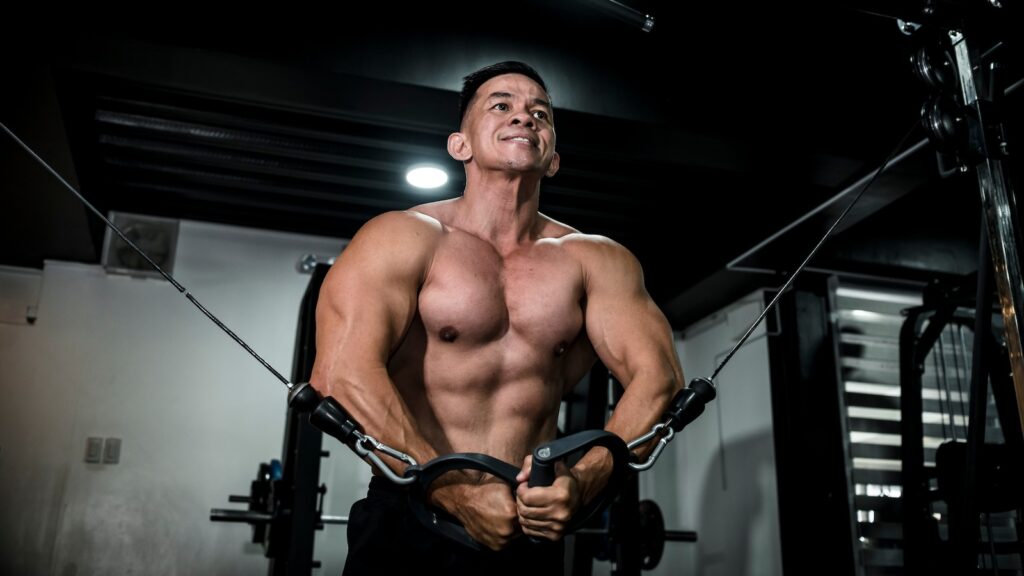
A typical query in coaching is whether or not low, medium, or high reps are finest for maximizing hypertrophy. A survey of 127 aggressive bodybuilders revealed that the majority educated throughout the seven- to 12-rep range. (1) This doesn’t essentially imply this vary is perfect for eachone. So, what rep vary is finest for muscle progress?
The Home of Hypertrophy tackled this query by referencing 5 current meta-analyses that in contrast high-load and low-load coaching for muscle hypertrophy.
[Related: Best Pre-Workouts]
Optimum Rep Vary
Analysis reveals that coaching near failure persistently results in comparable muscle progress throughout numerous hundreds. A meta-analysis evaluating excessive, reasonable, and low hundreds discovered no vital variations in hypertrophy. Excessive and low hundreds resulted in comparable beneficial properties in lean mass, total muscle measurement, and muscle fiber measurement. (2)
Most research reviewed recognized a really perfect rep vary between six and 35 repetitions, with the bulk utilizing an ordinary lifting tempo of 1 to 2 seconds for the concentric and eccentric. Slower rep speeds, due to this fact, don’t seem to supply further advantages inside this vary.
For instance, a research revealed within the European Journal of Utilized Physiology discovered that performing six to 10 reps with an exaggeratedly sluggish tempo — 10 seconds for lifting and 4 for reducing — was much less efficient for constructing muscle. (3)
In abstract, whether or not coaching with heavy or gentle hundreds, a reasonable rep vary with a standard lifting tempo is probably the most environment friendly method for muscle progress.
Research’ Issues
Throughout 5 meta-analyses, sure research targeted on untrained people, elevating the query of whether or not outcomes differ for educated people following a whole program. Fortuitously, two research particularly examined educated members, every performing three units per train.
One group labored within the eight to 12-rep vary to failure, whereas the opposite educated with 20 to 35 reps to failure. (4)(5) The findings revealed comparable muscle progress in each teams, additional supporting that hypertrophy can happen successfully throughout a variety of repetitions.
Excessive & Low Reps On Muscle Twitch Fibers
Analysis signifies that performing between six and 35 reps can result in comparable muscle progress. Does the kind of progress differ relying on the rep vary?
Some argue that high-rep coaching targets slow-twitch muscle fibers, whereas low-rep coaching focuses on fast-twitch fibers. Early research supported this concept, although they lacked consistency in key variables just like the variety of units, rest intervals, and rep approach. (6)
A current meta-analysis examined this matter and located that slow-twitch and fast-twitch fibers can develop equally throughout a broad vary of rep schemes. (7) Greater hundreds are inclined to activate each fiber varieties extra readily, whereas decrease hundreds might initially interact solely slow-twitch fibers. Quick-twitch fibers are recruited as fatigue units in and reps method failure.
How Heavy Can You Elevate?
To find out if muscle progress is feasible with fewer than six reps, assessing whether or not coaching at one’s one-rep max (1RM) can successfully stimulate hypertrophy is important. 4 research investigated this query. (8)(9)(10)(11)
In these research, one group carried out three to 4 units of eight to 12 reps, whereas the opposite group tried their 1RM as much as 5 instances per session. The outcomes confirmed vital muscle progress within the eight to 12 rep vary, whereas coaching at 1RM led to little or no hypertrophy.
Different analysis suggests that coaching within the two-to-four rep vary reveals some muscle progress potential. (12) Nonetheless, many of those research didn’t standardize elements such because the variety of units or relaxation intervals, leaving room for variability. Primarily based on the broader physique of proof, relying solely on the two-to-four rep vary for hypertrophy isn’t really useful.
How Excessive Many Reps?
Performing over 35 repetitions at 30% of your one-rep max (1RM) can produce hypertrophy akin to finishing eight repetitions at 80% of your 1RM. (13) One other research noticed educated people performing three to 5 units to failure, utilizing various 1RM intensities throughout completely different teams:
- 20% 1RM — 64 reps
- 40% 1RM — 30 reps
- 60% 1RM — 17 reps
- 80% 1RM — 12 reps
Teams within the 40-80% vary achieved comparable ranges of hypertrophy, whereas the 20% group additionally skilled muscle progress, although to a lesser extent than the opposite circumstances. (14)
Fatigue
A 2021 research suggests greater reps can result in extra vital muscle injury and longer recovery instances than decrease repetitions. (15) Greater reps can nonetheless play a helpful position in a well-rounded coaching program. Research point out greater repetitions may be as efficient as decrease repetitions when adjusting relaxation intervals. (16)(17)
Coaching To Failure
Leaving reps in reserve may end up in hypertrophy beneficial properties just like coaching to failure when performing fewer reps and heavier hundreds. Nonetheless, for higher-rep units, reaching failure could also be obligatory to maximise muscle progress. (18)
Analysis reveals that coaching removed from failure, particularly with lighter hundreds, tends to supply much less hypertrophy than coaching nearer to failure. (19)(20) Stopping just some reps wanting failure with lighter hundreds is as efficient as pushing to failure. (21)
The Home of Hypertrophy recommends incorporating various rep ranges into coaching to overcome plateaus, offered nutrition and different coaching fundamentals are in place.
References
- Hackett, D. A., Johnson, N. A., & Chow, C. M. (2013). Coaching practices and ergogenic aids utilized by male bodybuilders. Journal of power and conditioning analysis, 27(6), 1609–1617. https://doi.org/10.1519/JSC.0b013e318271272a
- Lopez, P., Radaelli, R., Taaffe, D. R., Newton, R. U., Galvão, D. A., Trajano, G. S., Teodoro, J. L., Kraemer, W. J., Häkkinen, Okay., & Pinto, R. S. (2021). Resistance Coaching Load Results on Muscle Hypertrophy and Energy Achieve: Systematic Evaluation and Community Meta-analysis. Drugs and science in sports activities and train, 53(6), 1206–1216. https://doi.org/10.1249/MSS.0000000000002585
- Schuenke, M. D., Herman, J. R., Gliders, R. M., Hagerman, F. C., Hikida, R. S., Rana, S. R., Ragg, Okay. E., & Staron, R. S. (2012). Early-phase muscular variations in response to slow-speed versus conventional resistance-training regimens. European journal of utilized physiology, 112(10), 3585–3595. https://doi.org/10.1007/s00421-012-2339-3
- Schoenfeld, B. J., Peterson, M. D., Ogborn, D., Contreras, B., & Sonmez, G. T. (2015). Results of Low- vs. Excessive-Load Resistance Coaching on Muscle Energy and Hypertrophy in Effectively-Skilled Males. Journal of power and conditioning analysis, 29(10), 2954–2963. https://doi.org/10.1519/JSC.0000000000000958
- Morton, R. W., Oikawa, S. Y., Wavell, C. G., Mazara, N., McGlory, C., Quadrilatero, J., Baechler, B. L., Baker, S. Okay., & Phillips, S. M. (2016). Neither load nor systemic hormones decide resistance training-mediated hypertrophy or power beneficial properties in resistance-trained younger males. Journal of utilized physiology (Bethesda, Md. : 1985), 121(1), 129–138. https://doi.org/10.1152/japplphysiol.00154.2016
- Vinogradova, O. L., Popov, D. V., Netreba, A. I., Tsvirkun, D. V., Kurochkina, N. S., Bachinin, A. V., . . . Orlov, O. I. (2013). Optimization of coaching: New developments in protected power coaching. Human Physiology, 39(5), 511–523. https://doi.org/10.1134/s0362119713050162
- Morton, R. W., Sonne, M. W., Farias Zuniga, A., Mohammad, I. Y. Z., Jones, A., McGlory, C., Keir, P. J., Potvin, J. R., & Phillips, S. M. (2019). Muscle fibre activation is unaffected by load and repetition period when resistance train is carried out to process failure. The Journal of physiology, 597(17), 4601–4613. https://doi.org/10.1113/JP278056
- Mattocks, Okay. T., Buckner, S. L., Jessee, M. B., Dankel, S. J., Mouser, J. G., & Loenneke, J. P. (2017). Training the Check Produces Energy Equal to Greater Quantity Coaching. Drugs and science in sports activities and train, 49(9), 1945–1954. https://doi.org/10.1249/MSS.0000000000001300
- Buckner, S. L., Yitzchaki, N., Kataoka, R., Vasenina, E., Zhu, W. G., Kuehne, T. E., & Loenneke, J. P. (2021). Do exercise-induced will increase in muscle measurement contribute to power in resistance-trained people?. Scientific physiology and purposeful imaging, 41(4), 326–333. https://doi.org/10.1111/cpf.12699
- Dankel, S. J., Counts, B. R., Barnett, B. E., Buckner, S. L., Abe, T., & Loenneke, J. P. (2017). Muscle variations following 21 consecutive days of power take a look at familiarization in contrast with conventional coaching. Muscle & nerve, 56(2), 307–314. https://doi.org/10.1002/mus.25488
- Dankel, S. J., Bell, Z. W., Spitz, R. W., Wong, V., Viana, R. B., Chatakondi, R. N., Buckner, S. L., Jessee, M. B., Mattocks, Okay. T., Mouser, J. G., Abe, T., & Loenneke, J. P. (2020). Assessing differential responders and imply adjustments in muscle measurement, power, and the crossover impact to 2 distinct resistance coaching protocols. Utilized physiology, vitamin, and metabolism = Physiologie appliquee, vitamin et metabolisme, 45(5), 463–470. https://doi.org/10.1139/apnm-2019-0470
- Schoenfeld, B. J., Contreras, B., Vigotsky, A. D., & Peterson, M. (2016). Differential Results of Heavy Versus Average Hundreds on Measures of Energy and Hypertrophy in Resistance-Skilled Males. Journal of sports activities science & medication, 15(4), 715–722.
- Ozaki, H., Kubota, A., Natsume, T., Loenneke, J. P., Abe, T., Machida, S., & Naito, H. (2018). Results of drop units with resistance coaching on will increase in muscle CSA, power, and endurance: a pilot research. Journal of sports activities sciences, 36(6), 691–696. https://doi.org/10.1080/02640414.2017.1331042
- Lasevicius, T., Ugrinowitsch, C., Schoenfeld, B. J., Roschel, H., Tavares, L. D., De Souza, E. O., Laurentino, G., & Tricoli, V. (2018). Results of various intensities of resistance coaching with equated quantity load on muscle power and hypertrophy. European journal of sport science, 18(6), 772–780. https://doi.org/10.1080/17461391.2018.1450898
- Farrow, J., Steele, J., Behm, D. G., Skivington, M., & Fisher, J. P. (2021). Lighter-Load Train Produces Higher Acute- and Extended-Fatigue in Exercised and Non-Exercised Limbs. Analysis quarterly for train and sport, 92(3), 369–379. https://doi.org/10.1080/02701367.2020.1734521
- Fink, J., Kikuchi, N., & Nakazato, Okay. (2018). Results of relaxation intervals and coaching hundreds on metabolic stress and muscle hypertrophy. Scientific physiology and purposeful imaging, 38(2), 261–268. https://doi.org/10.1111/cpf.12409
- Lim, C., Kim, H. J., Morton, R. W., Harris, R., Phillips, S. M., Jeong, T. S., & Kim, C. Okay. (2019). Resistance Train-induced Adjustments in Muscle Phenotype Are Load Dependent. Drugs and science in sports activities and train, 51(12), 2578–2585. https://doi.org/10.1249/MSS.0000000000002088
- Robinson, Z. P., Pelland, J. C., Remmert, J. F., Refalo, M. C., Jukic, I., Steele, J., & Zourdos, M. C. (2024). Exploring the Dose-Response Relationship Between Estimated Resistance Coaching Proximity to Failure, Energy Achieve, and Muscle Hypertrophy: A Collection of Meta-Regressions. Sports activities medication (Auckland, N.Z.), 54(9), 2209–2231. https://doi.org/10.1007/s40279-024-02069-2
- Lasevicius, T., Schoenfeld, B. J., Silva-Batista, C., Barros, T. S., Aihara, A. Y., Brendon, H., Longo, A. R., Tricoli, V., Peres, B. A., & Teixeira, E. L. (2022). Muscle Failure Promotes Higher Muscle Hypertrophy in Low-Load however Not in Excessive-Load Resistance Coaching. Journal of power and conditioning analysis, 36(2), 346–351. https://doi.org/10.1519/JSC.0000000000003454
- Terada, Okay., Kikuchi, N., Burt, D., Voisin, S., & Nakazato, Okay. (2022). Low-Load Resistance Coaching to Volitional Failure Induces Muscle Hypertrophy Much like Quantity-Matched, Velocity Fatigue. Journal of power and conditioning analysis, 36(6), 1576–1581. https://doi.org/10.1519/JSC.0000000000003690
- Nóbrega, S. R., Ugrinowitsch, C., Pintanel, L., Barcelos, C., & Libardi, C. A. (2018). Impact of Resistance Coaching to Muscle Failure vs. Volitional Interruption at Excessive- and Low-Intensities on Muscle Mass and Energy. Journal of power and conditioning analysis, 32(1), 162–169. https://doi.org/10.1519/JSC.0000000000001787
Featured picture by way of Shutterstock/MDV Edwards