
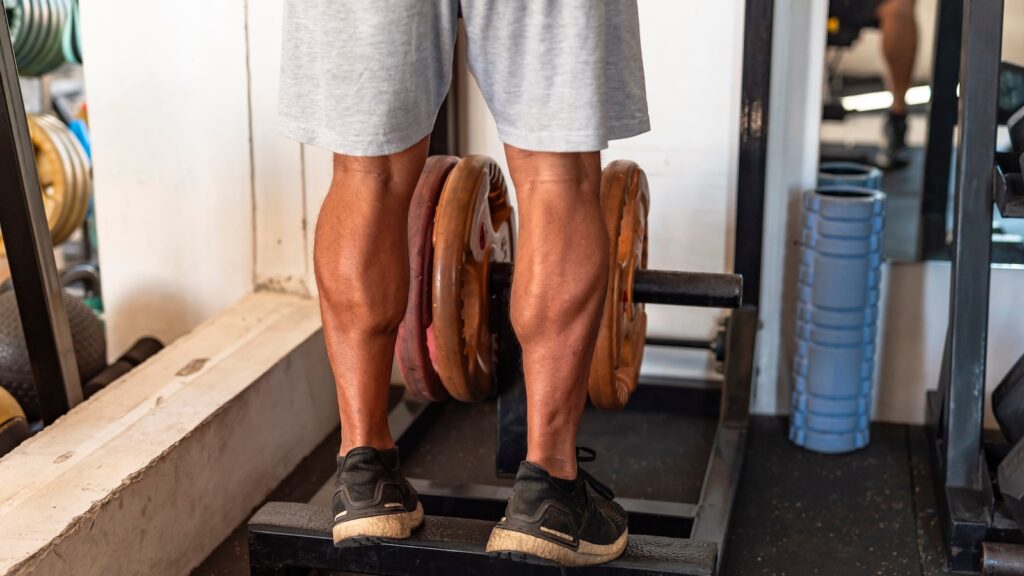
Correct coaching grows the calves like some other muscle group.
Final up to date on March twelfth, 2025

Robust calf muscles assist maintain balance, enhance running performance, assist explosive jumping, and promote upright posture. Creating the calves prevents lopsided, upper-body-heavy aesthetics with disproportionately smaller legs.
Some imagine calves are more difficult to develop than different muscle teams. Nonetheless, a number of research problem that notion, suggesting calves can develop like different muscle teams when present process comparatively equal stimuli.
[Related: Training Fasted vs. Fed — Which Makes You Stronger?]
Decrease Leg Protein Synthesis
The calves are composed of the gastrocnemius and the soleus muscle groups. The gastrocnemius has two components: lateral and medial heads. A 2004 examine that implies calves are notably difficult to develop noticed that, after 9 units of calf raises, the rise in soleus muscle protein synthesis was considerably decrease than usually seen in bigger muscle teams just like the quads. (1)
The researchers proposed two foremost causes for this:
- Frequent Activation: Calves are closely engaged in every day actions akin to standing and strolling. This fixed use makes them “chronically educated,” even in people who don’t train, probably decreasing their progress capability.
- Muscle Fiber Composition: The soleus is predominantly made up of slow-twitch fibers, that are typically thought of much less vulnerable to progress than fast-twitch fibers. Whereas slow-twitch fibers don’t develop as quickly, they will considerably expertise hypertrophy beneath correct coaching. (2)
Deciphering these findings as proof of restricted calf progress will be deceptive. Muscle protein synthesis doesn’t at all times immediately translate to muscle growth.
Whereas the soleus incorporates largely slow-twitch fibers, this doesn’t essentially imply its progress potential is inherently decrease. The gastrocnemius has a extra balanced mixture of slow- and fast-twitch fibers, suggesting that its progress capability might differ from the soleus.
Knowledge on Calf Progress
Muscle progress will be measured in two methods: absolute and relative. Absolute progress refers back to the uncooked improve in muscle dimension, such because the rise in centimeters when measuring muscle thickness. Relative progress represents the share improve in dimension.
A number of research on calf hypertrophy provide insights into how a lot the calves can develop:
Examine 1
A Japanese analysis group discovered that calf dimension elevated by 2% to six%, notably lower than the expansion noticed within the triceps and hamstrings. Nonetheless, when analyzing particular areas of the calves, the soleus muscle grew much less in comparison with different areas.
Progress within the lateral and medial gastrocnemius was similar to positive factors seen within the hamstring heads in absolute and relative phrases. (3)
Examine 2
A examine performed within the USA concerned contributors performing straight-leg calf raises and leg extensions, focusing on the calves and quadriceps. The outcomes confirmed that the gastrocnemius and quadriceps skilled related progress, with constant relative adjustments supporting this discovering. (4)
Examine 3
Brazilian researchers noticed important progress within the soleus muscle by way of straight-leg calf raises, highlighting its potential for hypertrophy with correct coaching. (5)
Examine 4
A Norwegian examine targeted on the gastrocnemius muscle, noting progress ensuing from straight-leg calf raises. (6)
Examine 5
German researchers discovered that the medial and lateral gastrocnemius muscle groups elevated in dimension when educated with straight-leg calf raises. (7)
These research recommend that whereas calf progress might typically seem barely decrease than different muscle teams, the variations aren’t dramatic. Calves typically develop inside a variety of 6% to twenty%, just like different muscle groups, demonstrating their potential for substantial hypertrophy with acceptable coaching.
Extremely Educated People Calf Analysis
Two research on calf progress in extremely educated people discovered the next:
Examine 1
The primary examine concerned an athlete with over a decade of calf coaching expertise. Over six weeks, the participant carried out three weekly units of straight-leg calf raises.
One leg was educated utilizing a full range of motion; the opposite alternated between lengthened and shortened partial ranges in every session. The outcomes confirmed that the leg educated with a full vary of movement skilled 4.14% extra progress within the medial gastrocnemius than the partially educated leg. (8)
Examine 2
The second examine adopted a aggressive bodybuilder with 18 years of coaching expertise. The participant accomplished 4 units of straight-leg calf raises 5 instances per week, paired with one hour of intense calf stretching six instances per week for twelve weeks. This routine resulted in important positive factors in calf thickness throughout numerous areas, starting from 7% to 23%. (9)
Does the gastrocnemius or the soleus develop quicker? Analysis presents blended findings. Some research recommend better progress within the soleus, whereas others point out that the gastrocnemius responds extra robustly.
A common consensus emerges: with correct coaching, the calves show a powerful capability for progress, making them a worthwhile focus for anybody trying to improve their growth.
Extra In Analysis
References
- Trappe, T. A., Raue, U., & Tesch, P. A. (2004). Human soleus muscle protein synthesis following resistance train. Acta physiologica Scandinavica, 182(2), 189–196. https://doi.org/10.1111/j.1365-201X.2004.01348.x
- Morton, R. W., Oikawa, S. Y., Wavell, C. G., Mazara, N., McGlory, C., Quadrilatero, J., Baechler, B. L., Baker, S. Ok., & Phillips, S. M. (2016). Neither load nor systemic hormones decide resistance training-mediated hypertrophy or energy positive factors in resistance-trained younger males. Journal of utilized physiology (Bethesda, Md. : 1985), 121(1), 129–138. https://doi.org/10.1152/japplphysiol.00154.2016
- Kinoshita M, Maeo S, Kobayashi Y, Eihara Y, Ono M, Sato M, Sugiyama T, Kanehisa H and Isaka T (2023) Triceps surae muscle hypertrophy is larger after standing versus seated calf-raise coaching. Entrance. Physiol. 14:1272106. doi: 10.3389/fphys.2023.1272106
- Burke, R., Piñero, A., Mohan, A.E. et al. Train Choice Differentially Influences Decrease Physique Regional Muscle Improvement. J. of SCI. IN SPORT AND EXERCISE (2024). https://doi.org/10.1007/s42978-024-00299-4
- Kassiano, W., Costa, B. D. V., Kunevaliki, G., Lisboa, F., Tricoli, I., Francsuel, J., Lima, L., Stavinski, N., & Cyrino, E. S. (2024). Larger Calves from Doing Larger Resistance Coaching Quantity?. Worldwide journal of sports activities drugs, 45(10), 739–747. https://doi.org/10.1055/a-2316-7885
- Larsen, S., Swinton, P.A., Sandberg, N.Ø., Kristiansen, B.S., Fredriksen, A.B., Falch, H.N., van den Tillaar, R., Wolf, M. (2024). Resistance coaching past momentarily failure: The results of lengthened supersets on muscle hypertrophy within the gastrocnemius. SportRχiv.
- Warneke, Ok., Wirth, Ok., Keiner, M., Lohmann, L. H., Hillebrecht, M., Brinkmann, A., Wohlann, T., & Schiemann, S. (2023). Comparability of the results of long-lasting static stretching and hypertrophy coaching on maximal energy, muscle thickness and suppleness within the plantar flexors. European journal of utilized physiology, 123(8), 1773–1787. https://doi.org/10.1007/s00421-023-05184-6
- Bischoff, A. B. G., Rigo, M. E. C., Wenzel, V. I., Laporta, L., & Pedrosa, G. F. (2024). Results of Six Weeks of Coaching at Totally different Ranges of Movement on Gastrocnemius Hypertrophy and Power: A Case Examine. Journal of Bodily Health, Drugs & Therapy in Sports activities, 10(5-Could 2024). https://doi.org/10.19080/JPFMTS.2024.10.555799
- Homer, Ok. A., Helms, E. R., & Spence, A. J. (2025). The impact of a mixed long-duration static stretching and resistance coaching routine on a aggressive bodybuilder: A case examine. Physiological studies, 13(2), e70156. https://doi.org/10.14814/phy2.70156
Featured picture Shutterstock/MDV Edwards