
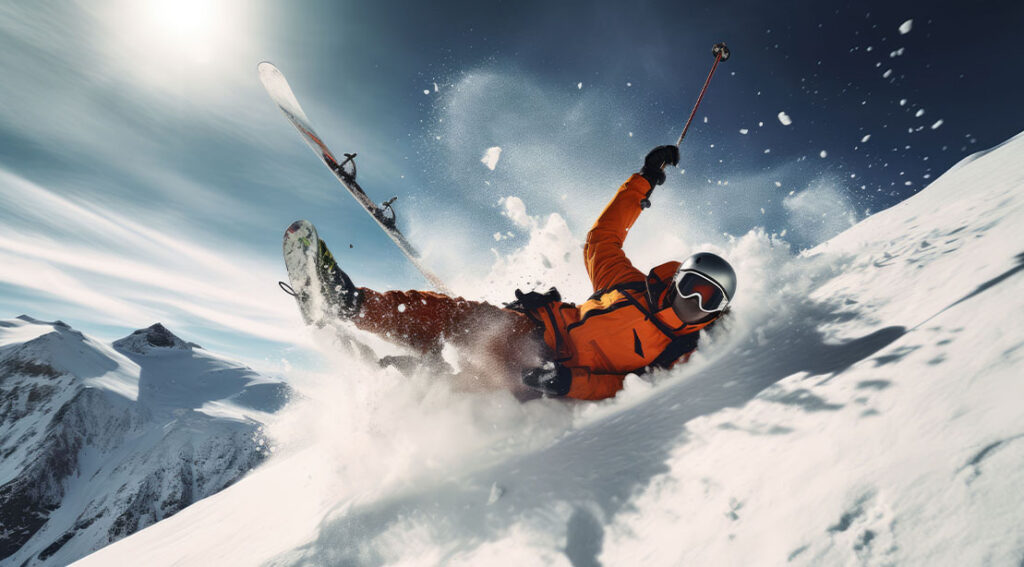
Snowboarding is an exhilarating full-body sport that delivers not simply an thrilling outside exercise, however a exceptional exercise as effectively. You’re not gliding down the slopes—snowboarding prompts a number of muscle teams, boosts cardiovascular well being, and sharpens your steadiness and coordination whereas torching energy. Relying in your dimension and ability stage, you possibly can burn a powerful 400 to 600 energy per hour however snowboarding accidents do happen irrespective of your stage.
Whereas snowboarding might help you preserve your health objectives in the course of the colder months and even support in your development as an athlete, the game carries a excessive threat of ski accidents and harm. Annually, round 600,000 folks undergo from skiing-related accidents. Though undesirable accidents can’t be prevented fully, you possibly can take easy measures to considerably scale back your threat of harm.
Forward, Jonah Drescher, former U.S. ski staff member, basic supervisor at Christy Sports, and proprietor of Thoughts Muscle, shares his high ideas for serving to you keep away from accidents on the slopes.
The Most Widespread Snowboarding Accidents and Why They Occur
It’s not stunning that knee accidents and concussions are the commonest ski accidents, in accordance with Drescher. “Minor muscle strains and small bruises or contusions typically happen when skiers and snowboarders push themselves past their health ranges.”
Whereas skipping a warm-up is a positive solution to improve the chance of harm, most ski accidents are sometimes brought on by extreme velocity that exceeds a skier’s potential. “Main accidents typically happen when this velocity is mixed with an affect with strong objects, corresponding to timber or rocks,” says Drescher. One other vital reason behind harm is collisions between skiers or snowboarders, which often occur when one or each people are uncontrolled and going too quick.
Easy Methods to Shield In opposition to Snowboarding Accidents
Getting ready your physique for snowboarding entails extra than simply being in form. Drescher affords strategies to strengthen and shield your physique in opposition to accidents all year long and affords a security examine on your tools and health stage.
Test Your Tools
Misfitted and un-tuned tools means you’re already beginning at an obstacle. Some issues to contemplate when inspecting your tools are age, put on and tear, and match to your sizing and talent. Many individuals borrow tools from a pal or relative that doesn’t match or is outdated (non-indemnified) and not secure. This may flip into lack of management whenever you get out on the hill.
- Test your boots to make sure they match accurately: “Boots must be comfortable and match, tighter than common footwear, and the bottoms must be in good situation with out an excessive amount of put on on the toes and heels,” says Drescher.
- Search for Rust: Are the sides of your skis (or snowboard) boring or rusted? Does the underside of your skis have gouges or scratches or look dry? In that case, it’s finest to keep away from snowboarding till your tools is as much as commonplace. Drescher recommends visiting your native ski store and speaking with an expert to make sure you use secure tools.
Don’t Skip the Warmup
Enhance your efficiency and scale back the chance of harm by correctly warming up earlier than you go well with up. Dynamic warm-ups permit blood movement to the muscle mass whereas aiding in gentle stretching. For 5 to 10 minutes, carry out these strikes back-to-back: Leg swings, lateral leg swings, lunges, excessive knees, arm circles, butt kicks, leaping jacks, and trunk rotations.
Know Your Health Limits
Drescher emphasizes the significance of understanding your expertise and health stage when heading out to the slopes. By recognizing your talents, you possibly can persist with trails which are appropriate for you with out getting into over your head. Understanding your health stage additionally permits you to gauge how lengthy you possibly can ski and plan vital breaks to stay recent, hydrated, and energized.
Stretch Extra
Drescher says a very powerful factor so as to add to your harm prevention guidelines is a stretching routine. “This may be so simple as including 15-Half-hour a day of full-body stretching at residence, sizzling yoga or sizzling stretching courses two to a few instances per week,” he says. The professional skier provides that these actions may be blended in with a power and conditioning class, making a well-rounded health stage primed for the hills.
Have the Correct Gear
“Ensure you have the right gear and tools to be out within the components,” Drescher says. This contains heat clothes, waterproof and weather-resistant jackets, pants, base layers, socks, helmets, and eye safety. “Mom nature can change shortly, and also you have to be prepared for it.” Many ski resorts could have you park away from the bottom of the mountain. If so, bringing a backpack or renting a locker on the base is a good preparation for altering situations.
Add These Strikes to Your Exercises
As with all energetic sport or exercise, preparation is the whole lot. “How we get our our bodies prepared for the ski day and ski season is a high precedence for the skier in stopping harm,” says Drescher, who recommends including core power, stretching, and ballistic exercise into your present health routine. A few of his favourite strikes for constructing power and stamina on the slopes embrace field jumps, planks, and body weight wall squats. Including these strikes into your present routine can support in higher management on the hills.
Fast Suggestions for Earlier than, Throughout, and After Snowboarding
- Get an excellent evening’s relaxation earlier than heading as much as the mountain.
- Familiarizing your self with the mountain’s format earlier than snowboarding will even contribute to a profitable expertise.
- Extra accidents occur once we are drained on the finish of the day. Don’t push your physique to ski when fatigued, which may result in harm.
- Take a gradual and simple warm-up run on the mountain to heat up your physique earlier than you ski.
- Take breaks all through the ski day to remain hydrated and have energy-boosting meals.
- In case you have minor bumps and strains, Drescher recommends icing these areas within the night for about quarter-hour (two to a few rounds). “Warmth feels good, however ice helps heal.” In the event you’re simply sore, reap the benefits of that sizzling tub at your lodge.” If injured, ice is the best choice.
Keep in mind, whereas there’s no magical resolution to fully forestall accidents, getting ready totally could make all of the distinction in guaranteeing a incredible winter exercise on the snowy slopes.