

You already know that stretching is important. It improves flexibility and mobility (one of many key components of fitness) and reduces the risk of injury. And when you don’t stretch, the muscular tissues can shorten and grow to be tight, which may restrict your vary of movement and put you in danger for joint ache or a pulled muscle.
However stretching is barely helpful if it’s executed appropriately. There are a couple of widespread stretching errors that may result in the precise reverse of what you’re searching for, comparable to harm and inflexibility. Listed here are eight pitfalls to keep away from so you’ll be able to enhance your flexibility and your exercises.
1. You’re Doing the Fallacious Kind of Stretching
There are two primary forms of stretching: static and dynamic. Static stretching is what you in all probability keep in mind from health club class: step by step stretching a muscle and holding a pose for about 30 seconds. Whereas it is a nice strategy to settle down from a exercise or improve normal flexibility, analysis means that static stretching earlier than a power exercise may very well trigger a decrease in performance.
“Throughout a warm-up, you need to do dynamic stretching, which boosts muscle activation and prepares muscular tissues to be highly effective by a full vary of movement,” says Trevor Thieme, CSCS. Dynamic stretches embody lunges, trunk rotations, leg swings, and jumping rope.
For the post-exercise “cool-down” interval, you’ll be able to give attention to static stretching to calm down the muscular tissues and launch stress. “Each forms of stretching may also help improve mobility,” Thieme says. “However one excites muscular tissues whereas the opposite calms them down.”
2. You’re Bouncing Whereas Stretching
Utilizing momentum from bouncing to pressure a muscle to stretch previous its regular vary (a.okay.a. ballistic stretching) might really feel prefer it’s serving to you improve your vary of movement. However as a substitute of loosening the muscle, this sort of fast stretching motion can really trigger the muscular tissues to tighten — a contraction referred to as the myotatic reflex or “stretch reflex.” This will result in accidents like muscle or tendon tears, Thieme says.
3. You’re Stretching Injured Muscular tissues
Stretching injured muscular tissues is “a giant no-no,” Thieme warns. Muscle strains usually occur when a muscle is stretched beyond its limit, so stretching it additional can irritate the harm. As an alternative, use the POLICE protocol (safety, optimum loading, ice, compression, and elevation) to assist the muscle heal.
4. You’re Overstretching

Whereas some discomfort is to be anticipated, it is best to by no means be in ache whereas stretching. “Overstretching may end up in muscle strains or extreme neural stress [stretching of the nerves],” says Lindsay Sudell, MOT, OTR/L, CFSS-3, CPT of Simply Stretch LA.
Overstretching may also result in hypermobility, “which is when a joint is just too free and thus unstable,” Thieme says. Know your limits whenever you’re stretching, and don’t pressure your self to transcend them.
5. You’re Not Stretching Persistently
It’s going to take various sporadic stretching classes to attain the flexibleness of a gymnast. Ideally, your stretching classes ought to be average and frequent reasonably than intense and occasional.
“In an effort to obtain bodily, everlasting change, stretching have to be constant for six to eight weeks,” says Sudell.
6. You’re Rushing By way of Your Stretches
“Individuals typically don’t stretch for the suitable period of time,” explains Sudell. She recommends aiming for 30 seconds or much less for pre-exercise stretches. For post-workout static stretching, intention to carry every stretch for at least 60 seconds.
7. You’re Not Doing Sport-Particular Stretches
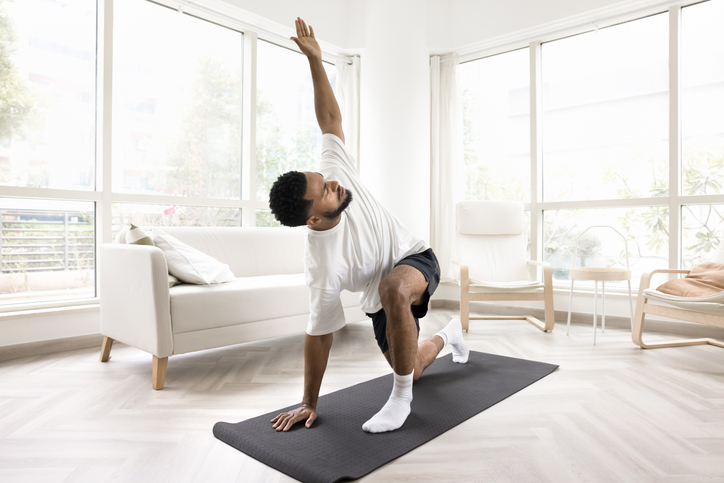
Sport-specific stretches “may be something focused towards actions {that a} specific athlete wants,” Sudell says. For instance, she says, golfers might give attention to stretches that enhance their spinal rotation and hip mobility, to allow them to hit the ball with maximal energy. Sprinters can heat up with dynamic stretches that simulate working and explosive actions, like walking lunges, butt kicks, and high knees.
Research additionally reveals that static stretches are higher suited to athletes who want flexibility (like gymnasts or dancers), whereas dynamic stretches are particularly helpful for individuals who must run or bounce (like basketball gamers or runners).
8. You’re Ignoring Your Respiration
Deep, diaphragmatic breathing “may also help calm down tense muscular tissues, and when paired with stretching, can enable for a fair deeper stretch with out growing the danger of harm,” Thieme says.
As well as, respiratory enhances the therapeutic impact of stretching, Sudell says. Analysis reveals that diaphragmatic respiratory can help the body recover after an intense exercise. The proper way to breathe throughout a stretch is to slowly inhale by the nostril, maintain for a second, then launch the breath by both the mouth or nostril, holding the diaphragm and stomach mushy and relaxed.